Culvert Asset Management Program - Internal Inspection System
Research & Development Project
Snapshot Overview
Project Dates: May 2024 through April 2025
Technical Skills Used:
-
Circuit Design & Analysis
-
Radio Frequency Transmission
-
Digital Image and Video Processing
-
Computer Aided Design
-
Additive and Subtractive Manufacturing
-
Design for Manufacturing (DFM)
-
Design for Usability and Maintainability
-
User Documentation Development
-
Project Management
-
Budget Management
Project Outcome(s):
-
Successful development of a complete system for use in internal inspections of culverts of diameter two feet and larger.
-
System composed of a wheeled inspection robot, a remote controller, a video receiver, a measuring reel, and a carrying pack for transportation to each culvert's inlet/outlet for inspecting.
-
-
Integration of 12V drill battery power system for ease of repairability and rechargeability as well as built-in safety mechanisms.
-
Implementation of both a drive camera (mounted to front plate) and inspection camera (pan/tilt mounted to lid) for obtaining uninterrupted inspection video during culvert navigation.
-
Publication and presentation of work at the 2025 International Conference on Transportation and Development in Glendale, Arizona.
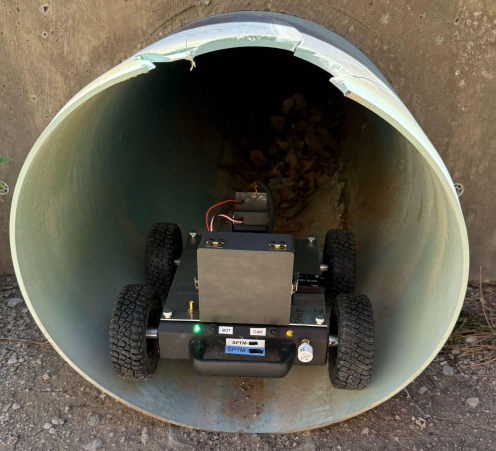
Internal Culvert Inspections
I was hired in May 2024 to lead a five-person engineering team to design and deploy a robotic inspection system capable of navigating culverts as small as two feet in diameter, carried hands-free by field inspectors to remote sites.
New Mexico Department of Transportation (NMDOT) has been asset mapping (locating, inventorying, and inspecting) all culverts located within the NMDOT right-of-way since 2021 in accordance with their Culvert Asset Management Plan (CAMP). The goal of the CAMP program is to provide educated planning for the construction, maintenance, and discontinuation of New Mexico's culverts. Prior to the start of the Robotic Inspection project, culvert asset mapping was primarily performed externally, except in culverts with 5-foot or larger openings.
The Robotic Inspection project came about as a response to the realization that an external inspection does not provide a comprehensive understanding of the health of a culvert. Internal culvert inspections are necessary in order to be fully aware of the state of culverts around New Mexico. Since a large percentage of the culverts in New Mexico have inlets of 4-feet or less, a robotic inspection system was deemed as a necessary tool for performing internal inspections for CAMP.

Throughout the project, the team analyzed a variety of possible configurations for the inspection robot (which we dubbed as "CulBot", short for Culvert Robot). I have linked my published paper describing in-depth the set-up of the system in the Related Publications section below. Important aspects of the robot system the team developed are:
-
The form factor of the finished system was designed and tested in performing internal inspections within culverts with diameters of 2-feet or larger.
-
A 12V drill battery was the chosen battery for the wheeled robot system. When inserted into the system, the battery is held in place and protected by a 3D-printed carbon-fiber reinforced nylon case. The choice of the drill battery allows for inspectors to have easier access to new batteries if one is lost or misplaced during an inspection day. Additionally, the battery was tested to run the system for a full 10-hour inspection day without needing charge.
-
The robot's inspection camera was mounted on the lid of the robot, allowing for an optimal point of view for inspection operators. The mount for the camera was assembled using 3D-printed carbon-fiber reinforced nylon. The design of the camera assembly allowed for full robot inversion without damage to the camera system. A light was designed into the camera assembly to allow for directional lighting in the culvert.
-
A digital video recorder (DVR) system was wired in line with the camera output to record and store all inspection video while the robot performed internal inspections.
-
A culvert navigation camera was added to the front panel of the robot to allow for improved navigation of culvert obstacles without interrupting the inspection camera feed.

Full System Design
Though the design and optimization of the inspection robot was of major importance, the development of a complete system was a vital task as well. Keeping in mind that inspectors needed to be able to transport the system to and from the culvert inlets/outlets, the team spent a reasonable amount of time determining the optimal transportation method for the inspection system.
A variety of solutions were tested. The final decision in terms of transporting the inspection system was a backpacking baby carrier. This may seem an unusual choice for transporting a robot, however, it worked very well for the inspectors' needs. The carrier was designed for taking long hiking trips and thus had straps and clips to allow the weight of the system to be evenly distributed upon the inspector's back. The carrier, like many backpacking packs, is built around a solid frame, which provided protection to the system in case of accidental falls. The carrier provided a perfect spot to strap the wheeled robot into place, with additional space below the main opening for the robot's controllers, backup batteries, and all other necessary equipment. The robot in its carrier is shown in the image to the left.
Related Publications

In order to share the system we created with others who may find it beneficial, I was tasked with authoring a paper for the 2025 International Conference on Transportation and Development held in Glendale, Arizona. The paper discusses in-depth all aspects of the system we developed, excluding the culvert navigation camera, which was fully realized after the publication of the paper. Co-authors on this conference paper with me were my research advisor (Civil & Environmental Engineering Department), supervisory team (Civil & Environmental Engineering Department), and academic advisor (Mechanical Engineering Department). The published paper and abstract can be found at the link below.
I was given the exciting opportunity to present a poster based on my paper while attending the 2025 International Conference on Transportation and Development in June of 2025. I was able to meet amazing people and learn a lot about civil engineering that I had not thought of previously (I have studied mechanical engineering throughout my education).